


Wildscape
Designer Diary by Sebastian Bleasdale
Part 1: The Mancala Mechanism
The design of Wildscape began many years ago, on a cold evening in Essen. I had met up for dinner with a fellow designer, Seth Jaffee, after a day at the Spiel 2014 games fair and we were talking about the action selection mechanism in Trajan. Trajan had a mancala system where each player had pieces in a number of bowls which they picked up and distributed clockwise one by one, taking an action from the final bowl. Seth and I agreed that there were different ways in which mancala systems could be used, and this area had a lot of untapped potential. Seth’s vision focused on developing customisability of actions, and became Crusaders: Thy Will Be Done which was published in 2018. My vision focused on sharing a single mancala between players. It took a lot longer to develop.
My vision was that each space gave a particular type of action, and the number of tokens in a particular location indicated how strong the action would become. When players took an action, they got an ability according to the number of tokens, then the tokens got distributed clockwise, making the action weak and gradually strengthening other actions. Unloved actions would gradually build up in strength until they were taken, creating a dynamic range of possibilities.
I’d recently started collaborating with a friend of mine, Ian Vincent, on a railway building game which had a problematic action selection mechanism. I suggested trying it out and the mancala mechanism slotted in and worked as smoothly as I had imagined. We repeatedly iterated on the design and the game developed beautifully and around 2018 was ready to be released into the world. Except … something was not right.
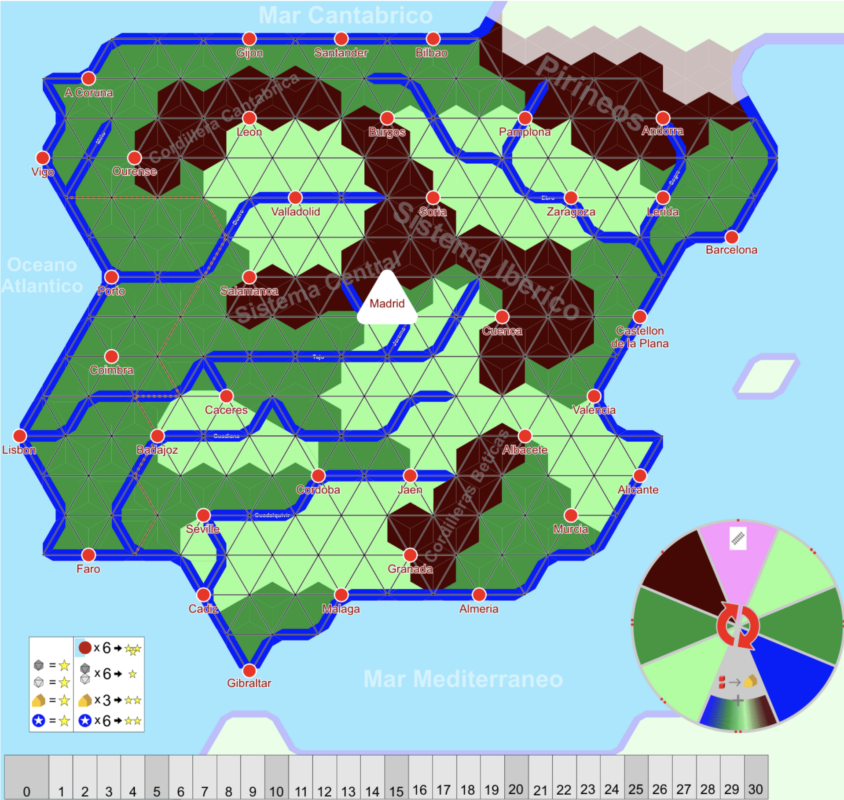
Exploring the mancala mechanism by rail
The mancala mechanism seemed like it was giving players lots of interesting choices – but the more experience Ian and I got with the game, the more we realised that it was nearly always correct to choose the location which gave the most builds (and optimise play so that you could use them all). We ripped out the mancala mechanic and replaced it with a superior system.
While the mancala mechanic wasn’t right for the railway building game, I was still convinced that the concept was good. It just needed a better execution. It needed a game designed around it to showcase what it could achieve. And thanks to the railway building game, I had a good idea of what it needed.
PART 2: IDEAS OF WORTH
In Part 1 of this diary, I talked about how I had created a mancala mechanism which showed promise – but needed a better execution. In real life, most things can be acquired at a broadly agreed value, but this is something which is deadly in central game mechanics. If everyone has the opportunity to pay the same to obtain exactly what they need, they’ll do this leaving all players in exactly the same spot and without an interesting game. Games are all about the restrictions placed on players – where access to resources vary between players and players consequently have very different ideas about what a particular action is worth.
I needed to ensure this differentiation existed in the mancala mechanism, and planned to introduce this in two main ways:
 Adding landscape tiles to each mancala space which the players received when they took the action. Landscape tiles are a great way to introduce things which have different values for different players, and the way that humans are hard-wired to understand maps means that you can introduce a lot of variety and complexity in a way which is relatively easy for players to handle.
Making the actions on each space more varied – one of the key issues with my previous attempt was that the game focused on track building, so most mancala locations focused on track building. These were much too similar to one-another. Instead, I wanted actions which were niche and interesting only in particular circumstances. This carries the risk that no player will be interested in a space at a given point in time – so to mitigate this I decided to give each space multiple actions so that players could always choose the other option.
With these changes, I was hopeful that the main mechanic would require players to balance three different aspects – the tile to be taken, the actions available, and the number of tokens driving actions – and that the importance of these aspects would vary during the game and between games depending on the players, their positions and their future strategies. I felt that this could be the heart of something amazing. All I needed now was the rest of the game.
In the Spiel 2019 games fair, I met up with Juma Al-JouJou from Karma games. He had seen success with his game Clans of Caledonia and was considering expanding Karma games to publish games from other designers. He liked my games and wondered whether I had something which matched his audience. I told him that I didn’t – but (thinking of the mancala mechanism) there was a game I was developing which might end up being suitable. He said that he’d be interested to see it at an earlier stage than usual and potentially help with development to ensure it really worked for Karma games.
With the central mechanic and a target audience, I set to work determining what the game surrounding the mancala should be. It took a lot of attempts. There were versions mining precious metals, creating a theme park, building empires and civilisations. There were versions where tiles had to be clustered in certain ways to score, with resource based economies, where houses needed to be completed. It also took a lot of time – not aided by the global pandemic which wiped out my free time and access to playtesters for a year and a half in the middle.
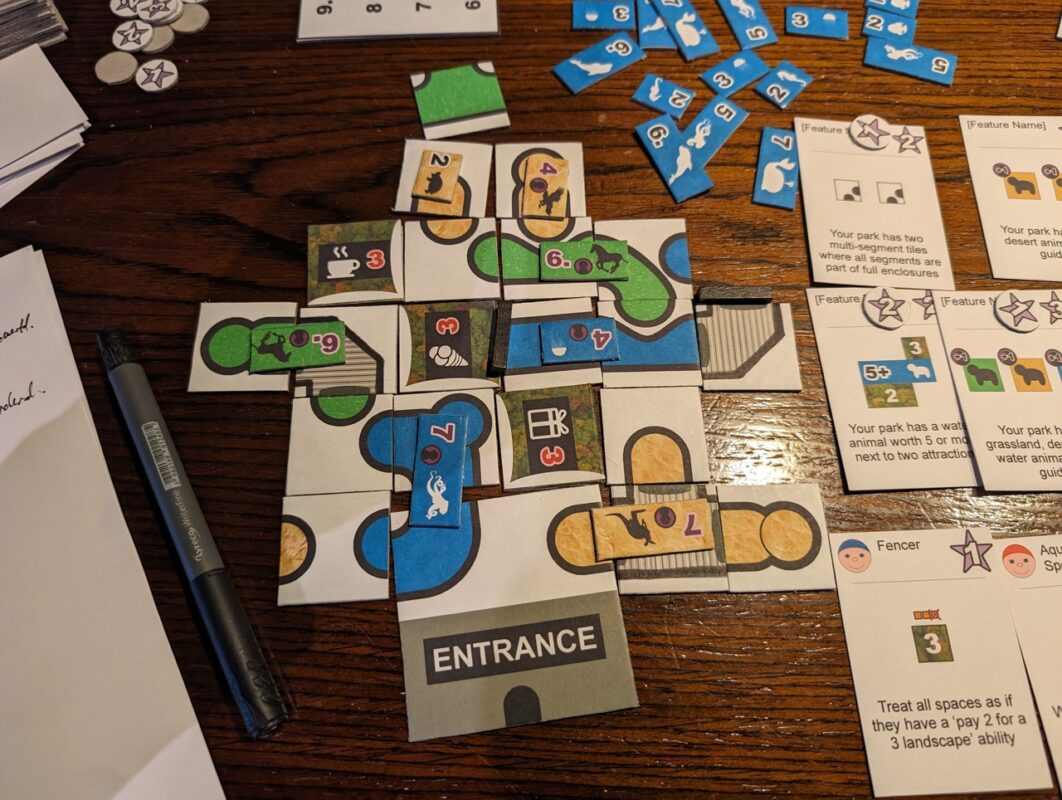
I ultimately settled on a game in which players collected tiles to build zoo enclosures for various animals, gained amenities if they got animals which satisfied certain conditions on cards, and players scored for their overall zoo. This allowed mancala actions to influence tile placement and the various animals, both of which fed through to the scoring. After a number of iterations I felt that the core of the game was really solid – it felt integrated and satisfying to play. However, it was not yet where it wanted to be – the theme didn’t really make much sense (in real life, the amenities you get in a zoo don’t depend on which animals you’ve acquired – imagine having to get multiple desert animals before you could build a cafe) and the end-game didn’t feel very satisfying.
There were a number of directions in which I could take the game’s development. Recalling Juma’s suggestion, I thought I’d get into contact with him again and see whether he thought the game might be suitable for Karma games, and if so, whether he had any preferences about the next steps. So I went to the Spiel 2023 games fair, taking my current prototype.

Early versions of Wildscape, when it was badly themed around zoo building
PART 3: FREEDOM WITHOUT WALLS
In part 2 of this designer diary, I discussed steps leading me to bring Wildscape to Karma Games when I met them at the Spiel 2023 games fair. The version I took was in no way finished – the graphics were crude, the rules unpolished and the theming was limited – even the name ‘Zoo Roundel’ was clearly a placeholder. However, they were happy to try the prototype out and give feedback.
On the games mechanics side, their feedback was not dissimilar to other feedback I’d already received. However, I received very insightful feedback on the thematic positioning from Juma, who heads Karma games. He said that while introducing animals worked well mechanically, building a zoo was not particularly aspirational for most people – and people who wanted to build a zoo were already well served by Ark Nova. As a vegan he particularly found building walls for enclosures to imprison animals unappealing and asked whether I had considered an ecosystem theme – developing spaces for animals without walls?

Losing walls and changing theme

That small twist in perspective was just what I needed to drive the next stages of development. Removing the zoo walls on the habitat tiles gave more freedom to place them, allowed more inventive play, and supported a switch to hexagonal tiles (also suggested by Juma). The change in scale meant that lands could be textured with mountains and rivers. And rather than creating a generic zoo which could be anywhere, I could focus on a landscape in a particular place, for which I chose Africa.
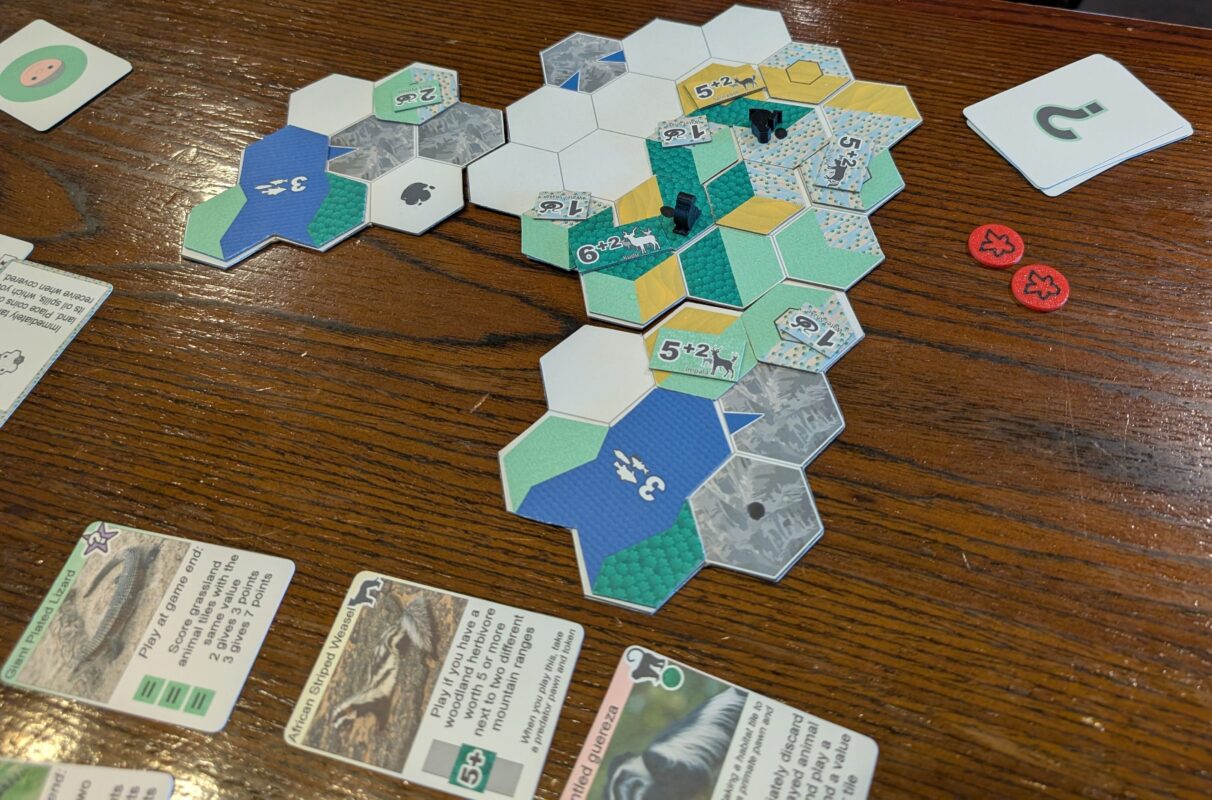
Going hexagonal
Most importantly, I decided in the new version of the game, essentially all scoring would be done through the animals you place. In the zoo version of the game, particular arrangements of animal enclosures allowed certain amenities to be placed. That never made much sense – building amenities isn’t usually particularly hard. But if the game was about creating habitats for animals and particular predators needed certain configurations of herbivore habitats to flourish, that would be compelling. And if we have herbivores and predators, what about the other animal types? What about birds, which fly between players depending on certain criteria? What about primates which helped you by performing certain actions? What about snakes which filled in ecological niches? Where do we fit all the other weird and wonderful animals?
It wasn’t all straightforward, mind you. There were numerous challenges and adjustments which were required to make the game work – a constant stream of ideas being considered and incorporated, cards and tiles and abilities being changed and rebalanced, and lots of comments and suggestions from my many playtesters (thank you all!)
All the while I kept Karma games looped in on developments, and they occasionally tried out various versions. Then, in early 2025 they decided we should move our informal collaboration onto a formal footing. They asked me to send them a ‘best current version’, played it, liked it and signed the game.
PART 4: SPECIALIST INTEREST
In the previous sections of this diary (part 1, part 2, part 3), I discussed how the mancala mechanism needs different players to have different ideas about what things are worth to function effectively. In addition to changing the mancala to achieve this, the surrounding game needs to encourage this. As a result, from a very early stage, Wildscape had specialists – cards which come into the game and give you one-off or ongoing special abilities.
In the early prototypes, players could use a mancala action to hire specialists, and each player had a maximum number which could be active at any time. The specialists were fun and certainly helped differentiate the players. However, the way players got them meant that the mechanic was very swingy – players who were lucky enough to chain specialists or get a couple of specialists who synergised well rocketed ahead while others floundered.
I’d seen and fixed this issue before, in my game Black Fleet. Early versions of the game allowed you to go through ongoing abilities in a similar fashion, resulting in a game which felt similar at the start and the end. Tying acquisition of these abilities to victory points meant that player powers were introduced gradually throughout the game, and the start and end felt very different.
Meanwhile, I had a different problem – while the actions on the roundel gave player interaction, the rest of the board play was relatively solitaire. I needed to give players reasons to care about what their opponents were doing.
I realised I could solve both issues by requiring players to get enough of a particular type of animal to get a corresponding specialist – and increasing the boundary as specialists of that type came out. Players would have to race their opponents for the specialists and the specialists would come into the game at a sensible pace.
Since each player would only get one specialist for each habitat type, this also allowed me to group the specialist abilities, to prevent any of the specialists synergising too well or too poorly with one-another. I ultimately ended up with five specialist categories – savannah specialists help turn-by-turn play, woodland specialists give immediate effects, wetland specialists interact with land tiles, desert specialists interact with animal cards, and river specialists give rewards for playing animals in a specific habitat.
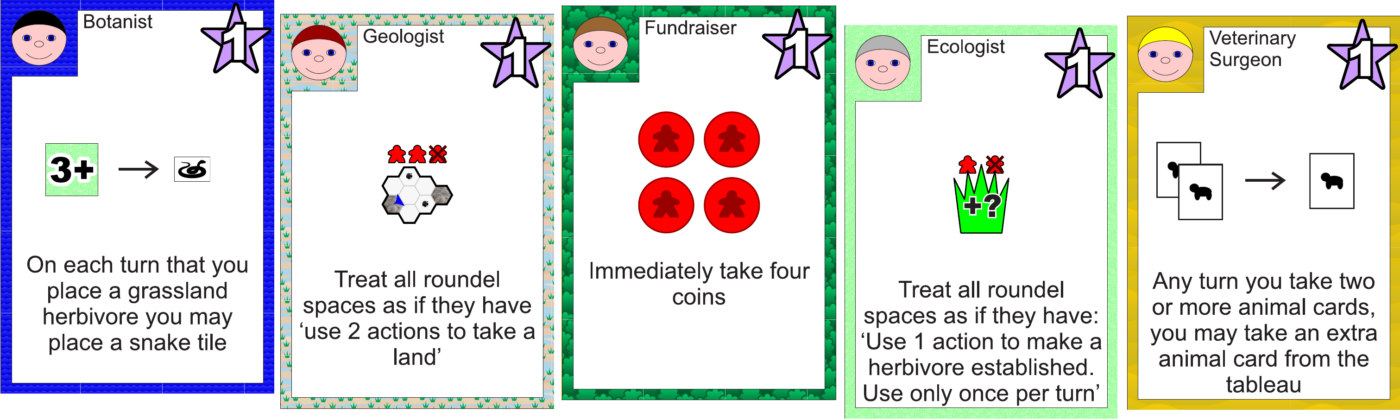
Specialists from the Wildscape prototype in 2025
Within each specialist type, it was important to me that all the specialists played differently – a desire that proved to be quite a challenge when Karma games signed the game and asked that I increase the number of specialists of each type to eight.
Why eight? Because specialists were an area where the level of complexity could easily be dialed up and down to suit different levels of player experience, and having two specialists per player would facilitate this.
The version of the game which I had been working on, where specialists are known from the start of the game, became the expert mode – and was improved by giving players a selection of two specialists of each type at the beginning rather than having the choice of specialist imposed. In its place, the standard mode had players select specialists from a choice of two when playing them, which helped prevent player overload when they didn’t have experience with the game and all its systems. And finally Karma games added an expert draft variant for competitive players who wanted to minimise the influence of chance.
It took some creativity to increase the specialist roster – but we were successful, allowing Wildscape to come with 40 distinct specialists helping to make every game unique.
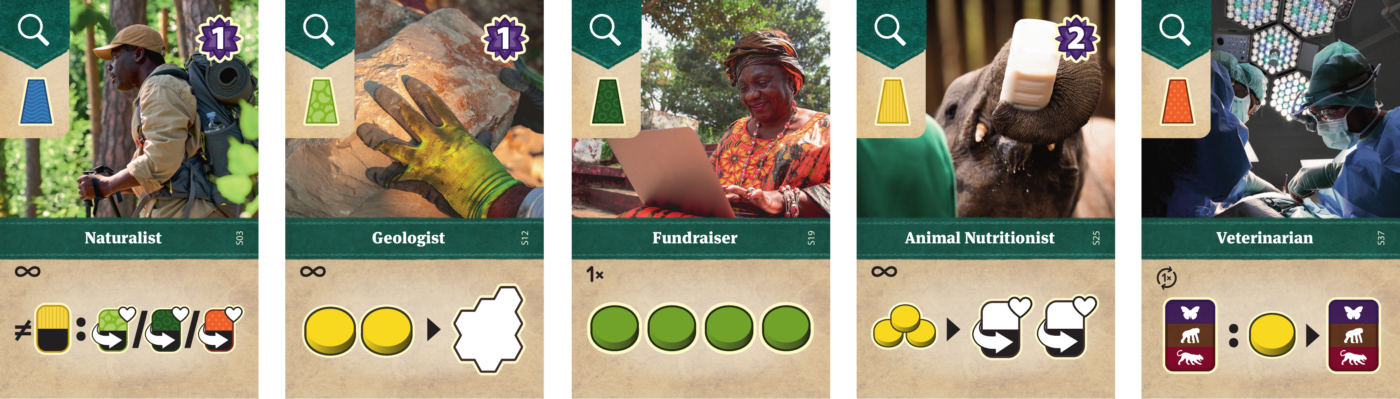
Specialists in the final game
PART 5: WHERE THE WILD THINGS ARE
As discussed in part 4, Wildscape’s design process did not end with the game being signed – in many ways it was kicked into overdrive, with a lot of intense testing and carefully targeted improvements. I have to commend Juma and his team at Karma games for the excellent work they did in identifying aspects of the game which could be improved and working to find better solutions.
When the game was signed, for example, neither predators nor primates were represented on your landscape. While they gave you points, they felt detached and not properly integrated. I’d tried various approaches to address this – but hadn’t come up with anything which justified the mechanical complexity. The most interesting version I’d tried was perhaps the one where predator pawns helped increase habitat size – which I’d abandoned because this made it harder to assess the size of the habitat and introduced odd timing issues.
That didn’t deter Karma Games, and after extensive discussions and numerous tests we worked out systems which added predator and primate meeples to the board in a way which made the game look nicer, was more thematic and added nuance to the gameplay.
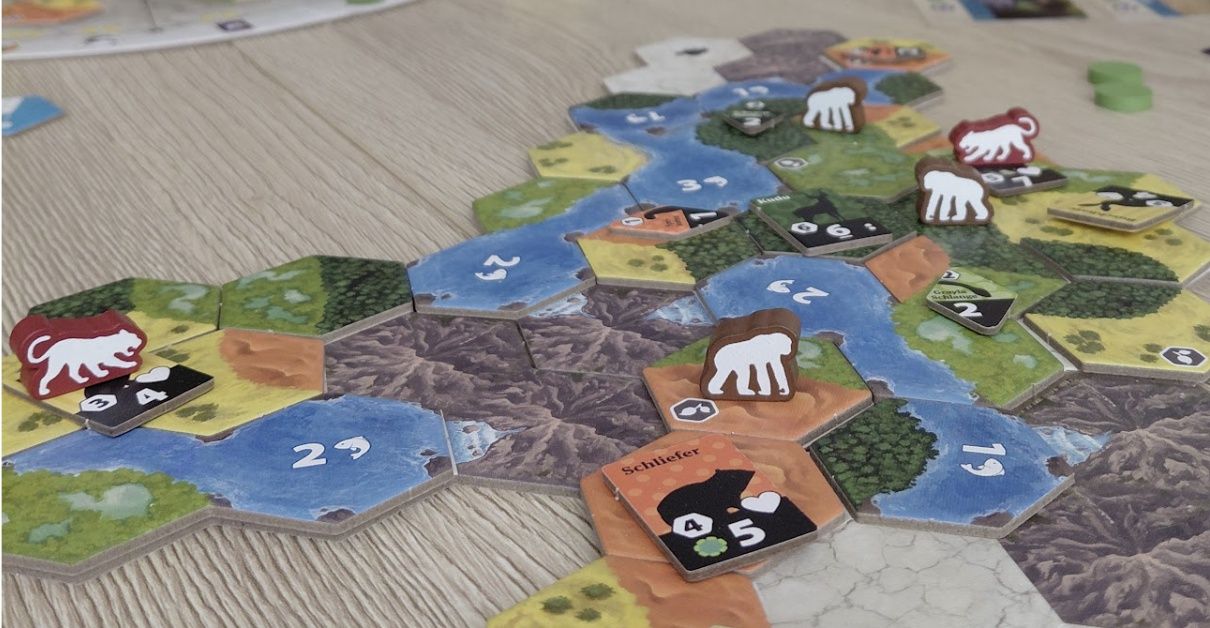
Ferocious beasts
In the new version, predators are placed on their prey – with larger prey giving more points. This incentivises players to place predators in a natural way – going after the larger more plentiful herbivores where possible – and avoids odd situations which emerged in earlier versions where all the predators could be satisfied by one single animal tile.
Primates, on the other hand, can be placed on any suitable habitat tile suitable for the species being played – provided it is at a suitable distance from other primates. They give points for similar terrain in the immediate vicinity, and their preference for woodlands is incorporated and helps balance the strength of woodland specialist cards.
Bird cards also saw changes – the submitted version had all players competing over a pool of birds (which scaled badly with different numbers of players) and this was switched to a version where you competed with each of your adjacent players for a subset.
But the most important change was to the acquisition of animal cards – for most of the game’s development, I’d relied on a system where players taking cards drew two and discarded one. This was switched to an approach with a lower level of luck with players drawing from a small tableau of cards.

Fauna, Primate, and Predator card tableau
Once the game was in a near final stage, I designed the solo player mode. When I design solo player modes, I like to have a simulated opponent whom I can beat – but want to ensure that the work required to run them is minimal so I can focus on playing the game rather than working out what the opponent must do. Having the opponent try and place habitat tiles and evaluate animal cards was therefore out of the question – instead I had the soloplay opponent use the mancala mechanism to gain animals directly. This worked out beautifully – although the opponent is not random and so plays smoothly, the tile draw introduces enough randomness that you feel you’re playing against the opponent rather than the soloplay mode turning into a puzzle.
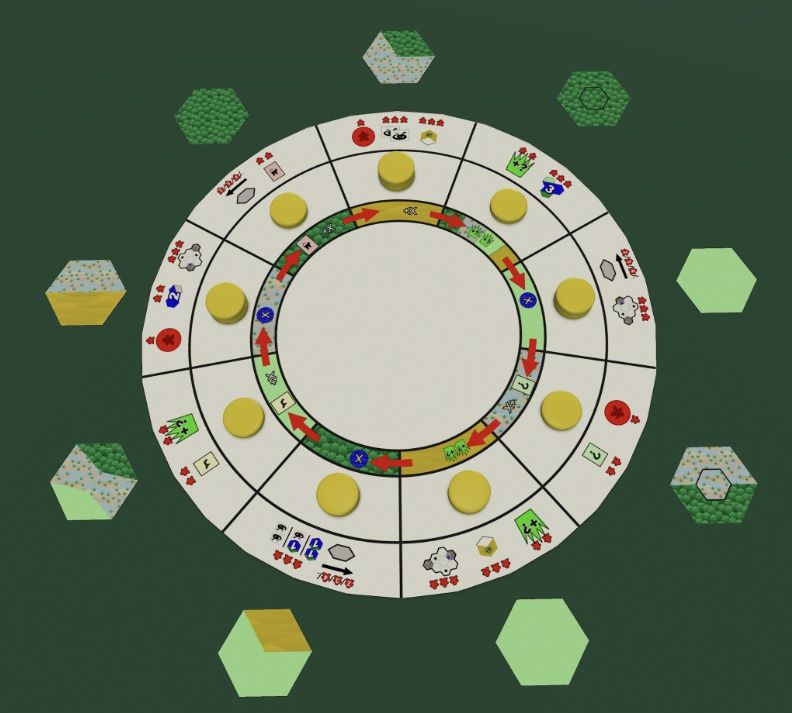
Prototype showing the central ring which dictates which habitat the solo opponent takes animals from.
While this was happening, Karma replaced my crude graphics with stunning art, inconsistent explanations with a thorough rulebook and player aids and throw-it-all-in-the-box storage with custom inserts (here on Instagram). I think they’ve done an outstanding job in both doing the final development and rendering the game into its final form.
Looking back over the course of development, the game’s come a long way since its initial conception in 2014, growing with me as a designer. Its measured development has allowed me to continually refine aspects of the game. It’s taken some time but I think, and I hope you’ll agree, that the end result is worth it.
If you’d like to comment or ask a question, you can on the original BoardGameGeek thread!