


Wildscape
Designer Diary von Sebastian Bleasdale
Teil 1: Der Mancala-Mechanismus
Die Entwicklung von „Wildscape“ begann vor vielen Jahren an einem kalten Abend in Essen. Ich hatte mich nach einem Tag auf der Spielemesse „SPIEL 2014“ mit meinem Kollegen Seth Jaffee zum Abendessen verabredet, und wir unterhielten uns über den Mechanismus zur Aktionsauswahl in „Trajan“. „Trajan“ verfügte über ein Mancala-System, bei dem jeder Spieler Spielsteine in mehreren Schalen hatte, die er nacheinander im Uhrzeigersinn aufnahm und verteilte, wobei er eine Aktion aus der letzten Schale ausführte. Seth und ich waren uns einig, dass es verschiedene Möglichkeiten gab, Mancala-Systeme einzusetzen, und dass dieser Bereich viel ungenutztes Potenzial barg. Seths Vision konzentrierte sich auf die Entwicklung der Anpassbarkeit von Aktionen und mündete in „Crusaders: Thy Will Be Done“, das 2018 veröffentlicht wurde. Meine Vision konzentrierte sich darauf, ein einziges Mancala zwischen den Spielern zu teilen. Die Entwicklung dauerte deutlich länger.
Meine Vision war, dass jeder Bereich eine bestimmte Art von Aktion ermöglichte und die Anzahl der Spielsteine an einem bestimmten Ort anzeigte, wie stark diese Aktion werden würde. Wenn Spieler eine Aktion ausführten, erhielten sie entsprechend der Anzahl der Spielsteine eine Fähigkeit; anschließend wurden die Spielsteine im Uhrzeigersinn verteilt, wodurch die Aktion an Stärke verlor und andere Aktionen nach und nach an Stärke gewannen. Ungeliebte Aktionen gewannen nach und nach an Stärke, bis sie ausgeführt wurden, wodurch sich ein dynamisches Spektrum an Möglichkeiten ergab.
Ich hatte vor kurzem begonnen, gemeinsam mit einem Freund von mir, Ian Vincent, an einem Eisenbahnbau-Spiel zu arbeiten, dessen Mechanismus zur Aktionsauswahl Probleme bereitete. Ich schlug vor, es einmal auszuprobieren, und der Mancala-Mechanismus passte perfekt hinein und funktionierte so reibungslos, wie ich es mir vorgestellt hatte. Wir überarbeiteten das Design immer wieder, und das Spiel entwickelte sich wunderbar und war etwa 2018 bereit, auf den Markt gebracht zu werden. Nur … irgendetwas stimmte nicht.
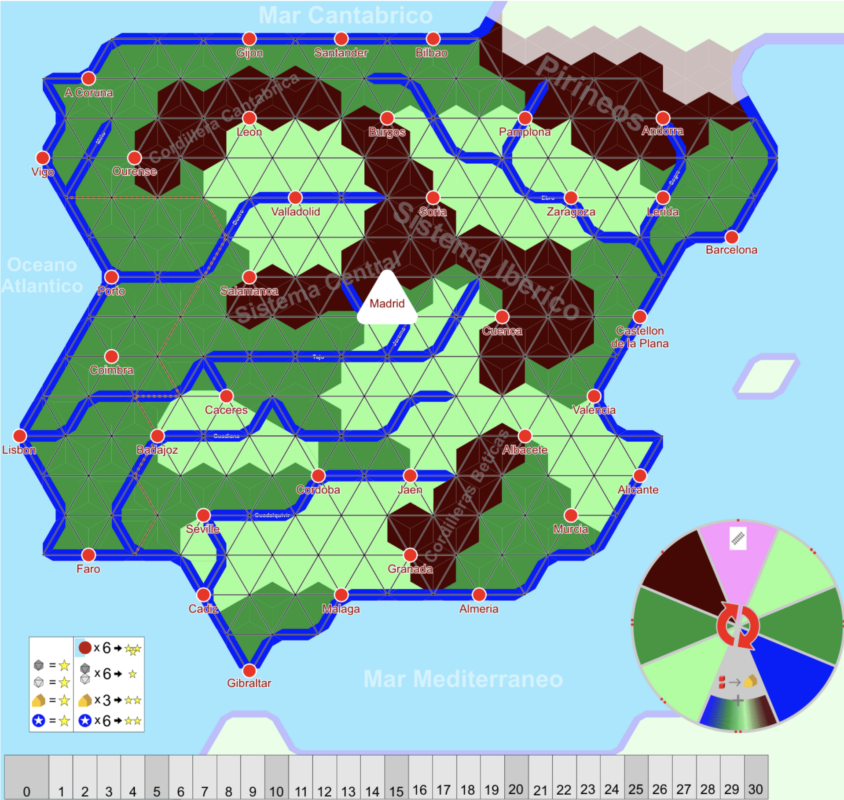
Den Mancala-Mechanismus auf Schienen erkunden
Der Mancala-Mechanismus schien den Spielern viele interessante Entscheidungsmöglichkeiten zu bieten – doch je mehr Erfahrung Ian und ich mit dem Spiel sammelten, desto mehr wurde uns klar, dass es fast immer die richtige Entscheidung war, den Ort zu wählen, der die meisten Bauplätze bot (und das Spiel so zu optimieren, dass man sie alle nutzen konnte). Wir haben den Mancala-Mechanismus gestrichen und durch ein besseres System ersetzt.
Auch wenn sich die Mancala-Mechanik nicht für das Eisenbahnbau-Spiel eignete, war ich dennoch davon überzeugt, dass das Konzept gut war. Es brauchte lediglich eine bessere Umsetzung. Es brauchte ein Spiel, das darauf zugeschnitten war, um zu zeigen, was damit möglich war. Und dank des Eisenbahnbau-Spiels hatte ich eine gute Vorstellung davon, was dafür nötig war.
PART 2: IDEEN VON WERT
In Teil 1 dieses Tagebuchs habe ich darüber berichtet, wie ich einen Mancala-Mechanismus entwickelt hatte, der vielversprechend war – aber einer besseren Umsetzung bedurfte. Im echten Leben lassen sich die meisten Dinge zu einem allgemein anerkannten Wert erwerben, doch in zentralen Spielmechaniken ist dies fatal. Wenn jeder die Möglichkeit hat, denselben Preis zu zahlen, um genau das zu erhalten, was er braucht, wird er dies auch tun, sodass alle Spieler genau an derselben Stelle stehen bleiben und kein interessantes Spiel entsteht. Bei Spielen dreht sich alles um die Einschränkungen, denen die Spieler unterliegen – wobei der Zugang zu Ressourcen von Spieler zu Spieler variiert und die Spieler folglich sehr unterschiedliche Vorstellungen davon haben, welchen Wert eine bestimmte Aktion hat.
Ich musste sicherstellen, dass diese Unterscheidung im Mancala-Mechanismus vorhanden war, und plante, dies auf zwei wesentliche Arten umzusetzen:
 Auf jedes Mancala-Feld, das die Spieler bei der Ausführung der Aktion erhalten haben, werden Landschaftskarten gelegt. Landschaftskarten eignen sich hervorragend, um Elemente einzuführen, die für verschiedene Spieler unterschiedliche Werte haben, und da Menschen von Natur aus darauf ausgerichtet sind, Karten zu verstehen, lässt sich auf diese Weise eine große Vielfalt und Komplexität schaffen, die für die Spieler relativ leicht zu bewältigen ist.
Die Aktionen auf den einzelnen Feldern abwechslungsreicher gestalten – eines der Hauptprobleme bei meinem vorherigen Versuch war, dass sich das Spiel auf den Gleisbau konzentrierte, sodass sich die meisten Mancala-Felder ebenfalls auf den Gleisbau bezogen. Diese waren einander viel zu ähnlich. Stattdessen wollte ich Aktionen, die Nischencharakter haben und nur unter bestimmten Umständen interessant sind. Das birgt das Risiko, dass sich zu einem bestimmten Zeitpunkt kein Spieler für ein Feld interessiert – um dies abzumildern, habe ich beschlossen, jedem Feld mehrere Aktionen zuzuweisen, sodass die Spieler immer die andere Option wählen können.
Mit diesen Änderungen hoffte ich, dass die Hauptmechanik die Spieler dazu zwingen würde, drei verschiedene Aspekte gegeneinander abzuwägen – das zu nehmende Spielfeld, die verfügbaren Aktionen und die Anzahl der Spielsteine, die die Aktionen steuern –, und dass die Bedeutung dieser Aspekte im Laufe des Spiels und von Partie zu Partie variieren würde, je nach den Spielern, ihren Positionen und ihren zukünftigen Strategien. Ich hatte das Gefühl, dass dies der Kern von etwas Großartigem sein könnte. Jetzt brauchte ich nur noch den Rest des Spiels.
Auf der Spiel 2019 traf ich mich mit Juma Al-JouJou von Karma Games. Er hatte mit seinem Spiel „Clans of Caledonia“ Erfolg gehabt und erwog, Karma Games zu erweitern, um auch Spiele anderer Designer zu veröffentlichen. Meine Spiele gefielen ihm, und er fragte mich, ob ich etwas hätte, das zu seinem Publikum passen würde. Ich sagte ihm, dass ich zwar nichts hätte – aber (mit Blick auf den Mancala-Mechanismus) gab es ein Spiel, das ich gerade entwickelte und das sich vielleicht als geeignet erweisen könnte. Er meinte, er wäre daran interessiert, es in einem früheren Stadium als üblich zu sehen und möglicherweise bei der Entwicklung zu helfen, um sicherzustellen, dass es wirklich zu Karma Games passe.
Nachdem die zentrale Spielmechanik und die Zielgruppe feststanden, machte ich mich daran, herauszufinden, wie das Spiel rund um das Mancala gestaltet werden sollte. Das erforderte zahlreiche Versuche. Es gab Varianten, in denen Edelmetalle abgebaut, ein Themenpark errichtet oder Imperien und Zivilisationen aufgebaut wurden. Es gab Varianten, bei denen Spielsteine auf bestimmte Weise gruppiert werden mussten, um Punkte zu erzielen, mit ressourcenbasierten Wirtschaftssystemen, in denen Häuser fertiggestellt werden mussten. Es hat auch viel Zeit gekostet – was durch die weltweite Pandemie nicht gerade erleichtert wurde, die mir eineinhalb Jahre lang meine Freizeit und den Zugang zu Testspielern genommen hat.
Nachdem die Kernmechanik des Spiels und die Zielgruppe feststanden, machte ich mich daran, herauszufinden, wie das Spiel rund um Mancala strukturiert werden sollte. Dies erforderte zahlreiche Versuche. Es gab Varianten, in denen die Spieler Edelmetalle abbauten, einen Themenpark bauten oder Reiche und Zivilisationen errichteten. Es gab Varianten, bei denen Spielsteine auf bestimmte Weise gruppiert werden mussten, um Punkte zu erzielen, sowie ressourcenbasierte Wirtschaftssysteme, in denen Häuser fertiggestellt werden mussten. Es hat auch viel Zeit in Anspruch genommen – ein Prozess, der durch die globale Pandemie nicht gerade erleichtert wurde, die mir eineinhalb Jahre lang meine Freizeit und den Zugang zu Testspielern raubte.
Es gab eine Reihe von Möglichkeiten, wie ich die Entwicklung des Spiels weiterverfolgen konnte. Ich erinnerte mich an Jumas Vorschlag und beschloss, mich erneut mit ihm in Verbindung zu setzen, um zu erfahren, ob er das Spiel für Karma Games geeignet fände und, falls ja, ob er bestimmte Vorstellungen bezüglich der nächsten Schritte hätte. Also fuhr ich mit meinem aktuellen Prototyp zur Spiel 2023.

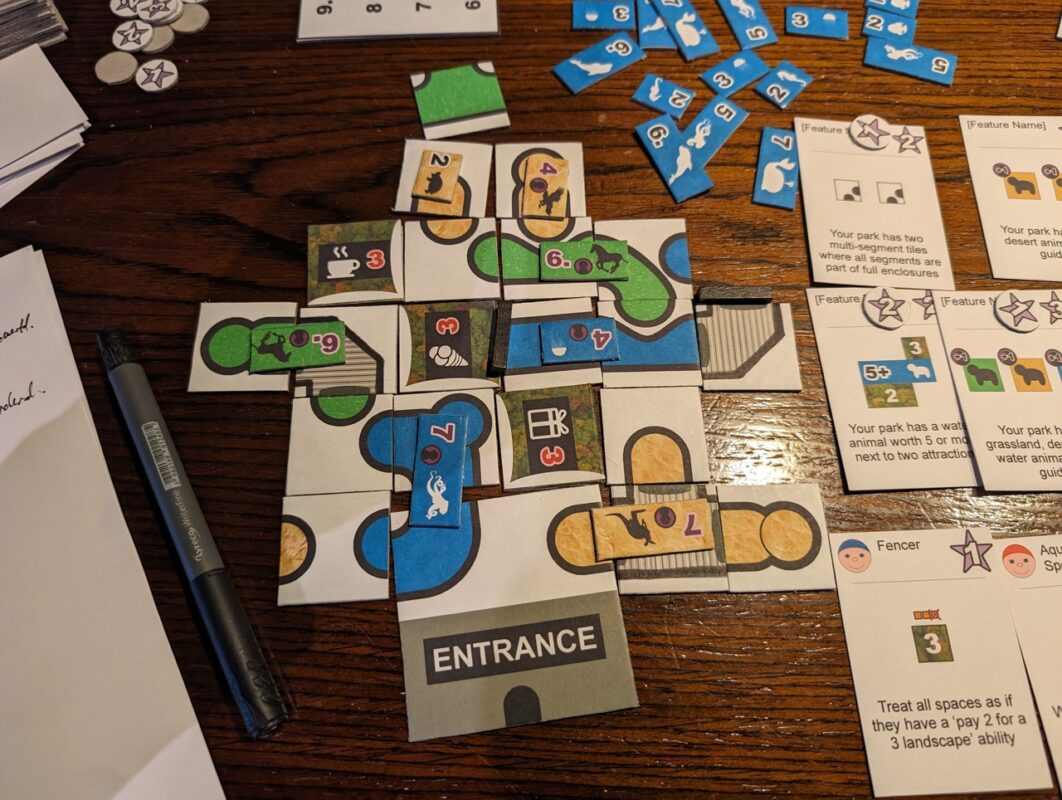
Early versions of Wildscape, when it was badly themed around zoo building
PART 3: FREEDOM WITHOUT WALLS
In part 2 of this designer diary, I discussed steps leading me to bring Wildscape to Karma Games when I met them at the Spiel 2023 games fair. The version I took was in no way finished – the graphics were crude, the rules unpolished and the theming was limited – even the name ‘Zoo Roundel’ was clearly a placeholder. However, they were happy to try the prototype out and give feedback.
On the games mechanics side, their feedback was not dissimilar to other feedback I’d already received. However, I received very insightful feedback on the thematic positioning from Juma, who heads Karma games. He said that while introducing animals worked well mechanically, building a zoo was not particularly aspirational for most people – and people who wanted to build a zoo were already well served by Ark Nova. As a vegan he particularly found building walls for enclosures to imprison animals unappealing and asked whether I had considered an ecosystem theme – developing spaces for animals without walls?

Losing walls and changing theme

That small twist in perspective was just what I needed to drive the next stages of development. Removing the zoo walls on the habitat tiles gave more freedom to place them, allowed more inventive play, and supported a switch to hexagonal tiles (also suggested by Juma). The change in scale meant that lands could be textured with mountains and rivers. And rather than creating a generic zoo which could be anywhere, I could focus on a landscape in a particular place, for which I chose Africa.
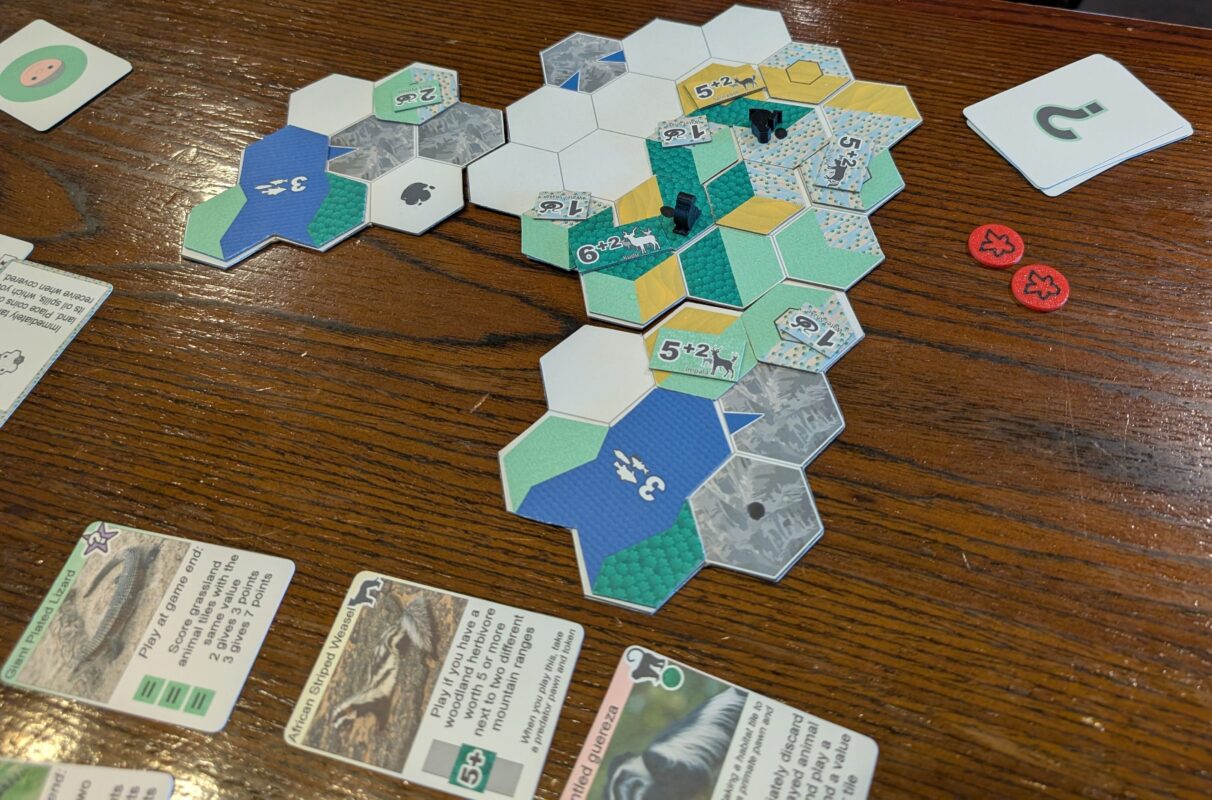
Going hexagonal
Most importantly, I decided in the new version of the game, essentially all scoring would be done through the animals you place. In the zoo version of the game, particular arrangements of animal enclosures allowed certain amenities to be placed. That never made much sense – building amenities isn’t usually particularly hard. But if the game was about creating habitats for animals and particular predators needed certain configurations of herbivore habitats to flourish, that would be compelling. And if we have herbivores and predators, what about the other animal types? What about birds, which fly between players depending on certain criteria? What about primates which helped you by performing certain actions? What about snakes which filled in ecological niches? Where do we fit all the other weird and wonderful animals?
It wasn’t all straightforward, mind you. There were numerous challenges and adjustments which were required to make the game work – a constant stream of ideas being considered and incorporated, cards and tiles and abilities being changed and rebalanced, and lots of comments and suggestions from my many playtesters (thank you all!)
All the while I kept Karma games looped in on developments, and they occasionally tried out various versions. Then, in early 2025 they decided we should move our informal collaboration onto a formal footing. They asked me to send them a ‘best current version’, played it, liked it and signed the game.
PART 4: SPECIALIST INTEREST
In the previous sections of this diary (part 1, part 2, part 3), I discussed how the mancala mechanism needs different players to have different ideas about what things are worth to function effectively. In addition to changing the mancala to achieve this, the surrounding game needs to encourage this. As a result, from a very early stage, Wildscape had specialists – cards which come into the game and give you one-off or ongoing special abilities.
In the early prototypes, players could use a mancala action to hire specialists, and each player had a maximum number which could be active at any time. The specialists were fun and certainly helped differentiate the players. However, the way players got them meant that the mechanic was very swingy – players who were lucky enough to chain specialists or get a couple of specialists who synergised well rocketed ahead while others floundered.
I’d seen and fixed this issue before, in my game Black Fleet. Early versions of the game allowed you to go through ongoing abilities in a similar fashion, resulting in a game which felt similar at the start and the end. Tying acquisition of these abilities to victory points meant that player powers were introduced gradually throughout the game, and the start and end felt very different.
Meanwhile, I had a different problem – while the actions on the roundel gave player interaction, the rest of the board play was relatively solitaire. I needed to give players reasons to care about what their opponents were doing.
I realised I could solve both issues by requiring players to get enough of a particular type of animal to get a corresponding specialist – and increasing the boundary as specialists of that type came out. Players would have to race their opponents for the specialists and the specialists would come into the game at a sensible pace.
Since each player would only get one specialist for each habitat type, this also allowed me to group the specialist abilities, to prevent any of the specialists synergising too well or too poorly with one-another. I ultimately ended up with five specialist categories – savannah specialists help turn-by-turn play, woodland specialists give immediate effects, wetland specialists interact with land tiles, desert specialists interact with animal cards, and river specialists give rewards for playing animals in a specific habitat.
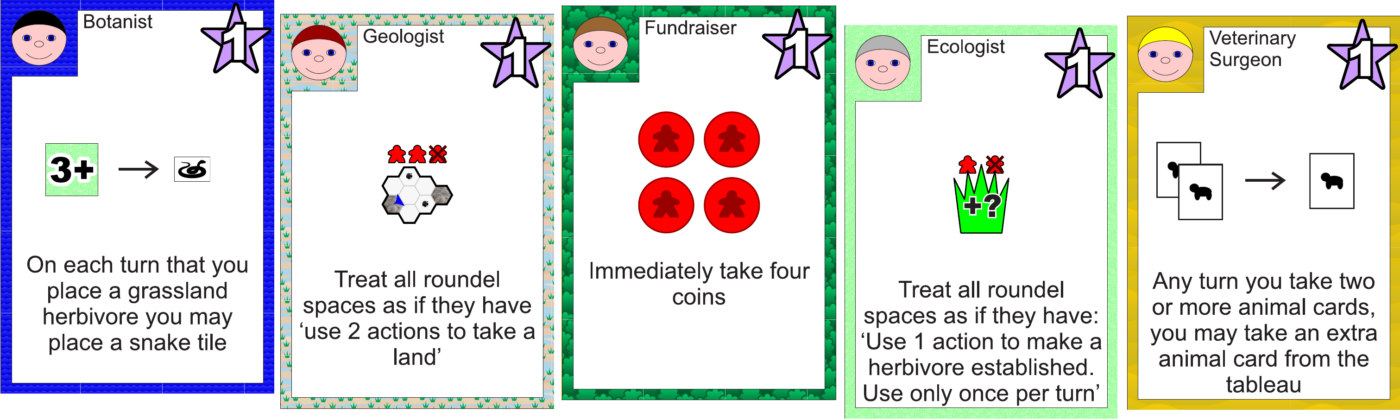
Specialists from the Wildscape prototype in 2025
Within each specialist type, it was important to me that all the specialists played differently – a desire that proved to be quite a challenge when Karma games signed the game and asked that I increase the number of specialists of each type to eight.
Why eight? Because specialists were an area where the level of complexity could easily be dialed up and down to suit different levels of player experience, and having two specialists per player would facilitate this.
The version of the game which I had been working on, where specialists are known from the start of the game, became the expert mode – and was improved by giving players a selection of two specialists of each type at the beginning rather than having the choice of specialist imposed. In its place, the standard mode had players select specialists from a choice of two when playing them, which helped prevent player overload when they didn’t have experience with the game and all its systems. And finally Karma games added an expert draft variant for competitive players who wanted to minimise the influence of chance.
It took some creativity to increase the specialist roster – but we were successful, allowing Wildscape to come with 40 distinct specialists helping to make every game unique.
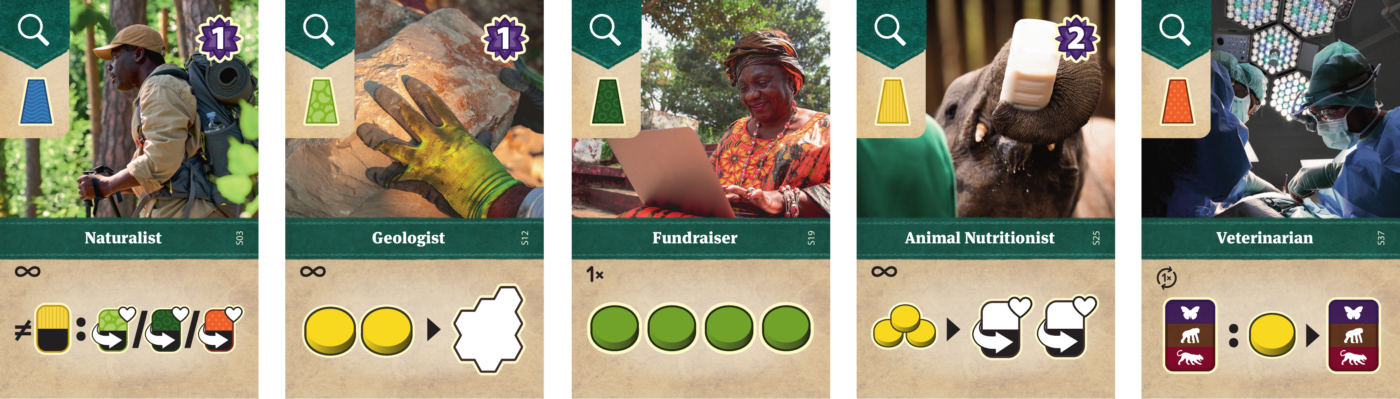
Specialists in the final game
PART 5: WHERE THE WILD THINGS ARE
As discussed in part 4, Wildscape’s design process did not end with the game being signed – in many ways it was kicked into overdrive, with a lot of intense testing and carefully targeted improvements. I have to commend Juma and his team at Karma games for the excellent work they did in identifying aspects of the game which could be improved and working to find better solutions.
When the game was signed, for example, neither predators nor primates were represented on your landscape. While they gave you points, they felt detached and not properly integrated. I’d tried various approaches to address this – but hadn’t come up with anything which justified the mechanical complexity. The most interesting version I’d tried was perhaps the one where predator pawns helped increase habitat size – which I’d abandoned because this made it harder to assess the size of the habitat and introduced odd timing issues.
That didn’t deter Karma Games, and after extensive discussions and numerous tests we worked out systems which added predator and primate meeples to the board in a way which made the game look nicer, was more thematic and added nuance to the gameplay.
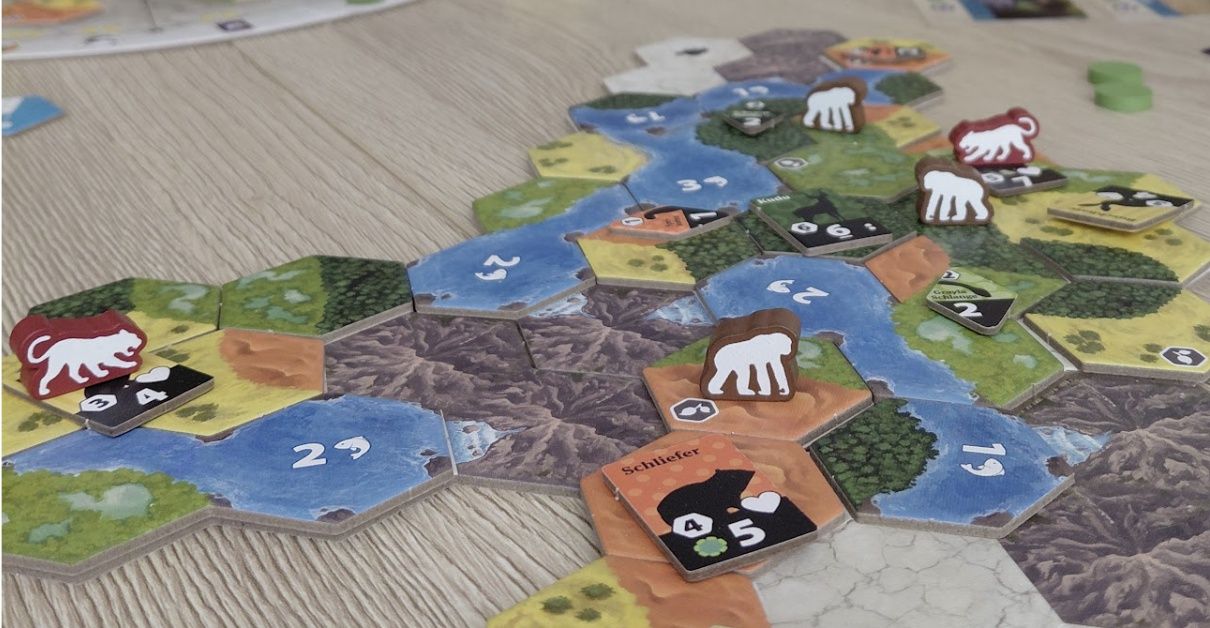
Ferocious beasts
In the new version, predators are placed on their prey – with larger prey giving more points. This incentivises players to place predators in a natural way – going after the larger more plentiful herbivores where possible – and avoids odd situations which emerged in earlier versions where all the predators could be satisfied by one single animal tile.
Primates, on the other hand, can be placed on any suitable habitat tile suitable for the species being played – provided it is at a suitable distance from other primates. They give points for similar terrain in the immediate vicinity, and their preference for woodlands is incorporated and helps balance the strength of woodland specialist cards.
Bird cards also saw changes – the submitted version had all players competing over a pool of birds (which scaled badly with different numbers of players) and this was switched to a version where you competed with each of your adjacent players for a subset.
But the most important change was to the acquisition of animal cards – for most of the game’s development, I’d relied on a system where players taking cards drew two and discarded one. This was switched to an approach with a lower level of luck with players drawing from a small tableau of cards.

Fauna, Primate, and Predator card tableau
Once the game was in a near final stage, I designed the solo player mode. When I design solo player modes, I like to have a simulated opponent whom I can beat – but want to ensure that the work required to run them is minimal so I can focus on playing the game rather than working out what the opponent must do. Having the opponent try and place habitat tiles and evaluate animal cards was therefore out of the question – instead I had the soloplay opponent use the mancala mechanism to gain animals directly. This worked out beautifully – although the opponent is not random and so plays smoothly, the tile draw introduces enough randomness that you feel you’re playing against the opponent rather than the soloplay mode turning into a puzzle.
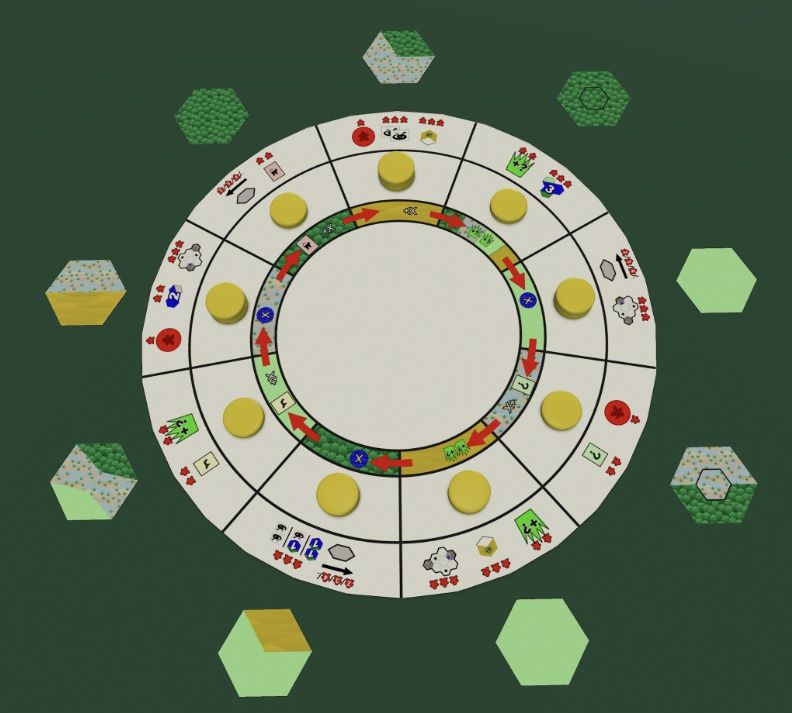
Prototype showing the central ring which dictates which habitat the solo opponent takes animals from.
While this was happening, Karma replaced my crude graphics with stunning art, inconsistent explanations with a thorough rulebook and player aids and throw-it-all-in-the-box storage with custom inserts (here on Instagram). I think they’ve done an outstanding job in both doing the final development and rendering the game into its final form.
Looking back over the course of development, the game’s come a long way since its initial conception in 2014, growing with me as a designer. Its measured development has allowed me to continually refine aspects of the game. It’s taken some time but I think, and I hope you’ll agree, that the end result is worth it.
If you’d like to comment or ask a question, you can on the original BoardGameGeek thread!